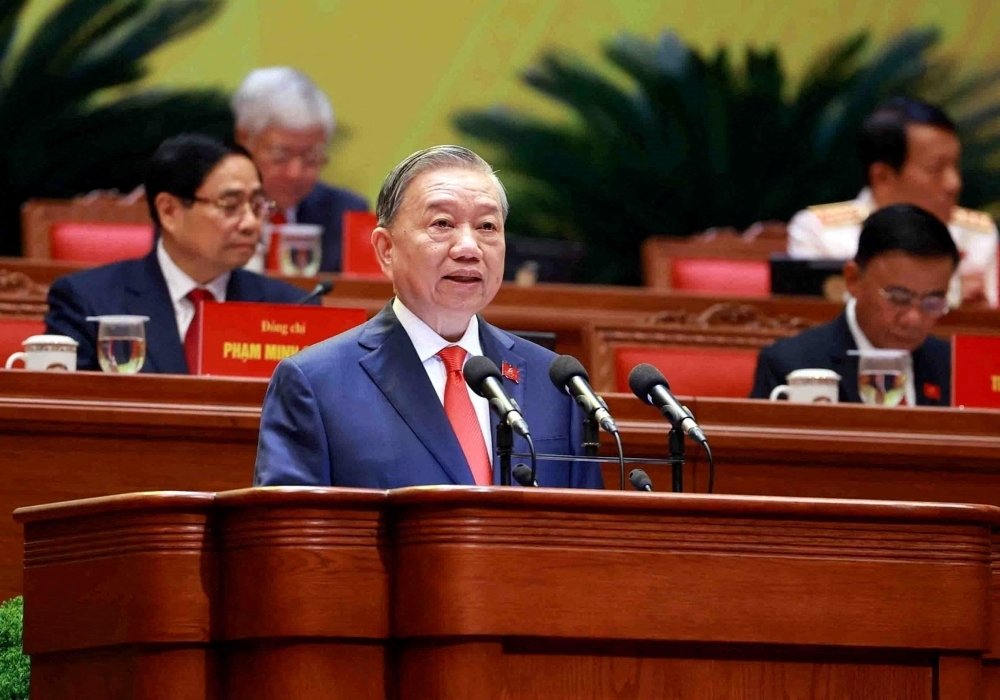
Vietnam’s political landscape entered a new chapter as To Lam was unanimously re-appointed as General Secretary of the ruling Communist Party, securing his leadership of the one-party state through 2030. The decision was confirmed at the end of the party’s five-year congress, where all 180 members of the newly formed Central Committee voted in his favour, underlining rare unity at the highest level of power.
In his address to party delegates, Lam pledged to preserve internal cohesion while acknowledging the scale of challenges ahead. His renewed mandate comes as Vietnam faces mounting pressure to sustain growth in an increasingly competitive global economy.
Since assuming the role in mid-2024, Lam has overseen rapid economic momentum driven by sweeping administrative and economic reforms. These changes, aimed at speeding up decision-making and cutting bureaucratic delays, earned him strong backing from reform-minded officials and business leaders. At the same time, they sparked controversy, particularly after tens of thousands of civil servants lost their jobs during the restructuring of public administration.
Aware of the tensions his policies created, Lam moved early to consolidate support across rival factions within the Communist Party, including the influential military establishment, according to officials familiar with the internal process. As concerns grew over his perceived support for private conglomerates, Lam issued a directive ahead of the congress reaffirming the central role of state-owned enterprises, including strategically important firms such as army-linked telecoms and defence group Viettel.
Political observers say Lam’s rise reflects careful planning. Le Hong Hiep, senior fellow at the ISEAS Yusof Ishak Institute, noted that Lam has long been known for meticulously preparing his moves. As former state security minister, Lam navigated Vietnam’s complex power structures to reach the top in 2024, at a time when his predecessor Nguyen Phu Trong was grappling with prolonged health problems.
His re-election is widely seen as a signal of continuity and stability, a key consideration for foreign investors who have helped transform Vietnam into a global manufacturing hub. At 68, Lam is also widely expected to seek the presidency, with an official announcement anticipated soon.
However, analysts caution that combining the roles of party chief and president — a structure similar to that adopted by China under Xi Jinping — could strain Vietnam’s traditional system of collective leadership and internal checks and balances.
Addressing delegates earlier this week, Lam laid out his boldest vision yet: pushing Vietnam’s annual economic growth above 10 percent for the rest of the decade. This target significantly exceeds World Bank forecasts, which project average growth of around 6.5 percent in the near term.
To achieve this, Lam plans to overhaul Vietnam’s long-standing growth model, shifting away from reliance on low-cost labour and exports toward innovation, productivity, and efficiency. His goal is to elevate Vietnam to high-middle-income status by 2030. Central to this plan is the most extensive reform of public administration in decades, a process Lam has vowed to continue despite concerns over financial risks, large-scale infrastructure projects, and allegations of favouritism.
Beyond the statistics and power dynamics, Lam’s renewed leadership carries real human consequences. For millions of Vietnamese citizens, his promises translate into hopes for better jobs, higher wages, and a more efficient state that serves people rather than slows them down. For those who lost positions during reforms, the future remains uncertain. As Vietnam stands at a crossroads, the next five years will determine whether ambition, stability, and reform can truly improve everyday life for its people, not just the numbers on an economic chart.